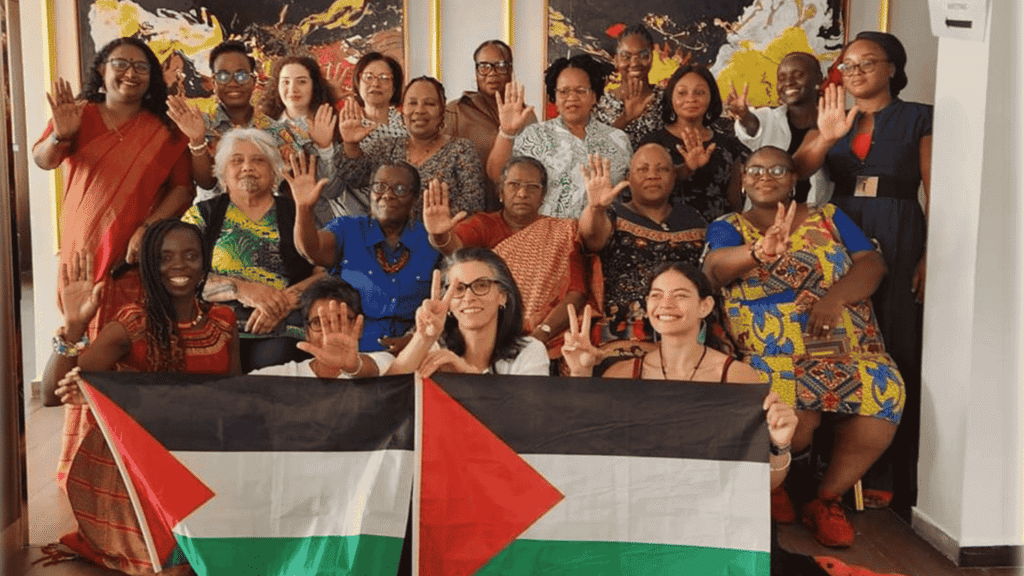
The Global South Dialogue on the Decoloniality of Violence Against Women and Girls (VAWG) was held in Accra, Ghana, from 15–17 December 2023. It was organized by the Gender Studies and Human Rights Documentation Centre in collaboration with the International Network to End Violence Against Women and Girls (INEVAWG). The dialogue brought together feminists, activists, academics, and civil society actors from the Global South to critically examine violence against women and girls through a decolonial and intersectional feminist lens.
INEVAWG is a Global South–led feminist network focused on centering the lived experiences of Black women and other women facing intersectional discrimination. Building on its 2023 strategic consultation, the dialogue aimed to re-politicize violence against women and girls by situating it within historical, structural, and colonial contexts. Participants emphasized that colonial legacies continue to shape legal systems, economic structures, social relations, and cultural norms in the Global South, thereby perpetuating patriarchy, inequality, and violence.
The dialogue sought to explore how a decolonial framework can deepen current work on ending violence against women and girls, strengthen policy and programming, and contribute to meaningful change in women’s lives. A key learning question proposed for 2024 was: What would it take to decolonize and re-politicize violence against women and girls in ways that are valuable to Global South actors and transformative on the ground?
Early sessions examined the impact of colonialism on family laws, marriage and inheritance systems, economic exploitation, racism, casteism, patriarchy, religion, and knowledge production. Participants identified how colonial legal systems, capitalist economic models, and Eurocentric family structures have marginalized women, erased indigenous practices, commodified communal resources, and normalized violence. Themes such as food insecurity, land dispossession, alcohol abuse, ethnic discrimination, and the transformation of spirituality into oppressive religious institutions were highlighted across regions.
Session Two focused on decoloniality and feminism, emphasizing that decoloniality recognizes the ongoing nature of colonial power relations rather than treating colonialism as a historical event. Participants debated the meaning of feminism within their contexts, questioning Western feminist frameworks and universal definitions. Discussions stressed the importance of indigenous knowledge, language, contextualization, and dismantling binaries created by colonial thinking. Feminism was broadly framed as a non-hierarchical, justice-oriented struggle for liberation, bodily autonomy, shared power, and dignity, rooted in local realities and histories.
Intersectionality emerged as a key analytical tool for understanding how overlapping systems of oppression, such as racism, sexism, capitalism, religion, nationalism, caste, and class—produce and reinforce violence against women and girls. Participants explored the concept of structural violence, showing how laws, policies, economic systems, and social norms collectively create conditions that normalize inequality and harm. Examples were drawn from Africa, South Asia, the Arab region, and Indigenous communities, illustrating how global systems translate into local violence.
The dialogue also addressed the challenges faced by feminist movements and NGOs, including donor dependency, lack of data, co-optation by colonial agendas, and internal power hierarchies. Participants called for deeper introspection, consciousness-raising, decolonization of justice and education systems, and stronger solidarity across movements.
In closing, INEVAWG issued a strong call for solidarity with Palestinian women and children, condemning ongoing violence and demanding accountability and justice. The dialogue concluded with a shared commitment to strengthening decolonial feminist practice, movement building, and collective action against violence in the Global South.
